Image Extractor

Image extractor for any public website

Paste a page URL and pull every image the page actually loaded. You keep the direct URLs and the files, so you can copy them or download a ZIP.

  • check_circle100% free
  • check_circleNo signup
  • check_circleDirect URLs
  • check_circleRenders JavaScript
image

35,713 image extractions and counting

Quick Extract: Images on this page onlyDeep Extract: Follows links across up to 3 pages
Checking…

shieldOnly download images you own or have permission to use. Respect each site's copyright and terms. Rights holders can request removal via our DMCA policy.

Extract your URL in a private tab. Nothing is sent to our servers. How it works

Add to Chrome

Extracted images will appear here.

What this image extractor does

This image extractor collects the images a public page actually loads in the browser. Paste the page URL and it opens the page in a headless browser, runs the scripts, scrolls to wake up lazy loaded files, then extracts every image source it finds from img tags, srcset and CSS backgrounds.

You get a plain list of image URLs you can copy into a sheet or script, plus previews you can filter and download. Each result keeps its original format and resolution, with duplicates and tracking pixels removed before you see the grid. If you only need the links, copy them without downloading anything.
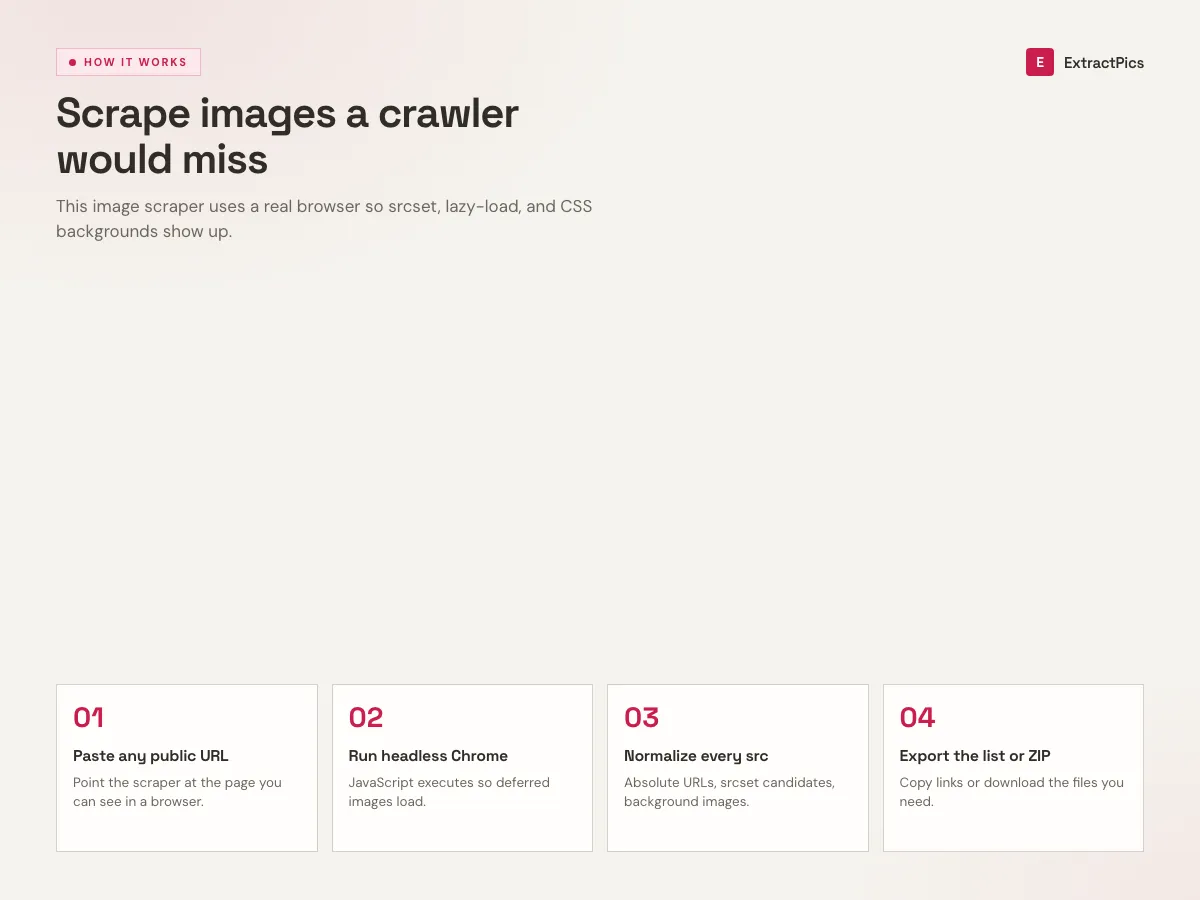
Guide for the image extractor showing how it pulls images from rendered webpages
Image extractor workflow covering render, discovery and export.

What this image extractor gives you

travel_explore

Renders before it extracts

The page opens in a real headless browser that runs JavaScript, so the extractor sees images that never appear in raw HTML.

link

Plain URL list to copy

Every image comes back as a direct link you can paste into a sheet, script or dataset without parsing markup.

image_search

Catches the hidden sources

It pulls srcset variants and CSS background images alongside normal img tags, so you get the full set.

When to use an image extractor

Use this when you need a list of image URLs and files without running your own browser automation.

Perfect for

  • checkCollecting image URLs for a dataset
  • checkAuditing which images a page loads
  • checkPulling assets for a site migration
  • checkChecking responsive srcset sources in one go
  • checkGrabbing every photo URL from search results
  • checkSkipping a custom Puppeteer script for a one off job

What you get

  • checkPaste a URL, get every image source
  • checkRuns the page JavaScript in a real browser
  • checkReads srcset and CSS background images
  • checkCopy direct URLs or download a ZIP
  • checkWorks on single page apps and infinite scroll
  • checkFree, no signup

How to extract images

  1. 01

    Paste the page URL

    Copy the address of any public page that shows the images you need.

  2. 02

    Run the extractor

    The tool renders the page in a headless browser, runs its JavaScript and scrolls so lazy loaded images appear.

  3. 03

    Copy or download

    Copy the direct image URLs for your own workflow or download the files as a ZIP.
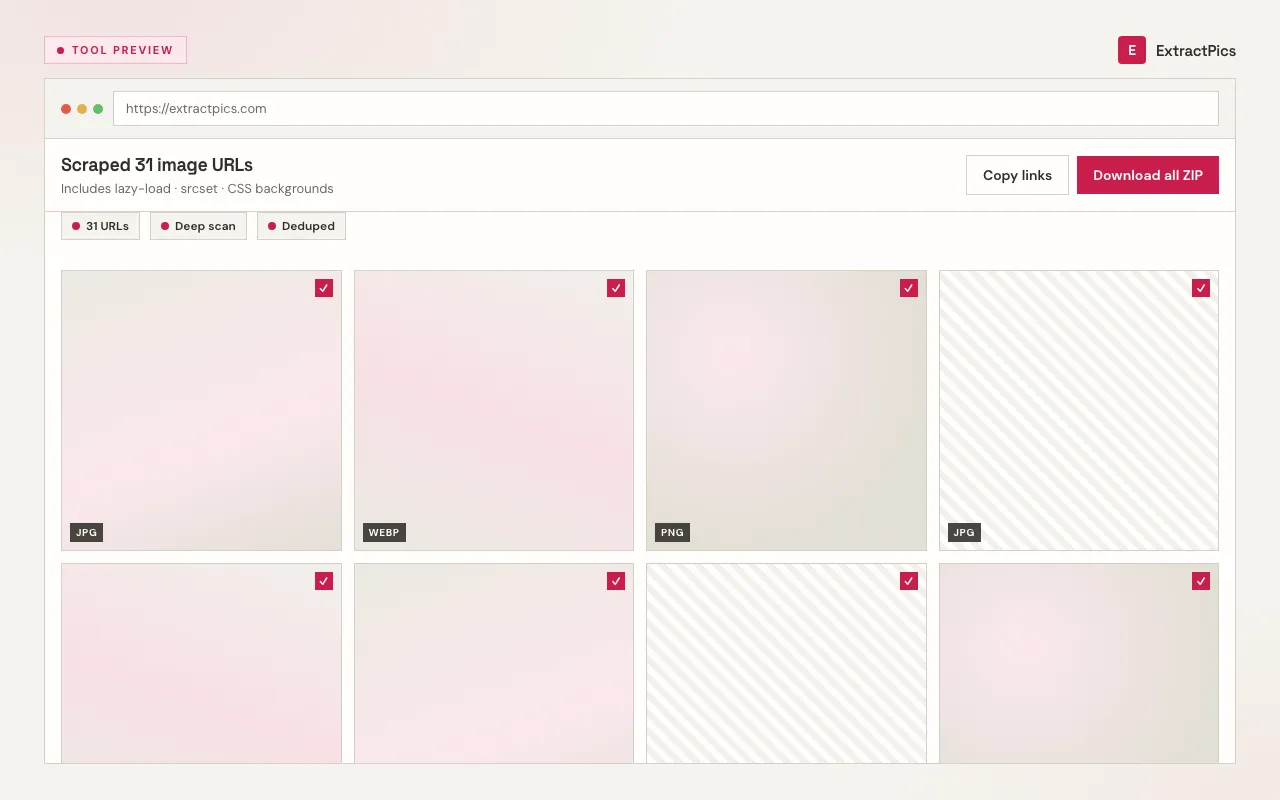
Image extractor results screen listing extracted image URLs with download actions
Image extractor results ready to copy or download as ZIP.

Why a real browser extractor

A plain HTML fetch only sees the first markup response. Modern pages add images as you scroll, swap in larger srcset versions, or paint them as CSS backgrounds. A fetch alone misses them.

Running the page in a real browser fixes that. ExtractPics waits for scripts to finish, scrolls the page to load what is below the fold, then extracts srcset and background images along with the normal tags. A gallery that looks empty to curl still returns a full list here.

This extractor vs a plain fetch

A fetch that only parses the first HTML response sees a fraction of a modern page. Rendering first closes that gap.

SourceHTML onlyThis extractor
Standard img tagsFoundFound
Lazy loaded on scrollMissedCaptured
srcset responsive sizesPartlyLargest kept
CSS background imagesMissedCaptured
JavaScript rendered imagesMissedCaptured

Frequently asked questions

If your question is not covered here, send us a message and include the page, file, or result type you are working with.

How do I extract images from a website?

Paste the page URL into the box above and run it. ExtractPics opens the page in a headless browser, extracts every image it loads, and shows you a list you can copy or download as a ZIP.

Is the image extractor free?

Yes. It runs in your browser with no signup. Paste a public URL and extract right away. Very heavy bulk use may hit a fair use limit.

Does it keep the original format and size?

Yes. Each file stays in the format it was published in and at the resolution the site served. We pick the largest srcset version we find.

Can I copy just the image URLs?

Yes. After the scan you get a plain list of direct image URLs. Copy one or copy all without downloading the files.

Does it work with lazy loaded pages?

Yes. The page is scrolled after it loads so images that appear on scroll are included before extraction.

Do I need to install anything?

No. It runs in the browser on desktop and phone. No extension and no app to install.

What is this image extractor?

ExtractPics is a free image extractor for public webpages. Paste a URL into the box, hit Extract, and wait a few seconds. We open the page in a real browser, collect the images it loaded, and show them so you can preview, filter, and download. You will usually get most of what is on the page. Login walls and private galleries are out of reach because we only see what a normal visitor sees.

How can I find specific images?

After a scan, use the format and size filters on the results toolbar. That is the fastest way to drop icons, skip tiny files, or keep only JPGs. Filenames show on each card, so you can scan for a product name or a known asset. Tick the ones you want and leave the rest. You do not have to download the whole pile.

What can I do with the results?

Preview every image in a grid. Filter by type or size. Copy one URL or copy all of them. Download a single file, or select several and get a ZIP. Quick Extract covers the page you pasted. Deep Extract follows a few linked pages when the set is paginated. There is no account required to try this.

How do I download images?

When the scan finishes, each image has its own download control. Click it to save that file at the size the site actually served. Nothing is recompressed and no watermark is added. If you only need the address, copy the URL instead.

Can I download multiple images at once?

Yes. Select the images you want, then use Download selected to pack them into a ZIP. Large sets take longer because each file is fetched from its original host. A few files may be missing from the ZIP if that host blocks the request. Download those ones individually, or open them in a new tab.

The extraction does not work. Why?

The usual causes: the page is not public, it sits behind a login, or it is so slow or heavy that it never finishes loading. Very large infinite-scroll feeds can also time out. Try again in a minute, try a shorter URL (a single product page instead of a huge homepage), or switch between Quick Extract and Deep Extract. If the site itself is down, we cannot invent images that never loaded.

The download does not work. Why?

Some sites stop other pages from hotlinking their files. The preview may say it failed, or a ZIP may skip that image. Right-click the preview if you have one, or open the image URL in a new tab and save it from there. If nothing downloads at all, write to us from the contact page with the URL you tried.

How does the image extractor work?

Each run opens your URL in a headless Chrome browser. We wait for the page to render, run its JavaScript, and scroll so lazy-loaded pictures appear. Then we collect img tags, srcset sources, CSS backgrounds, picture elements, and SVG. Tracking pixels and broken URLs are stripped before you see the grid.

Does it work with dynamic websites?

Yes. The page is viewed the same way you would view it in Chrome. Scripts run. Network requests get a chance to finish. Infinite-scroll and lazy-load galleries are the reason we bother with a real browser instead of reading static HTML. If a picture only exists after you scroll, we try to load it before collecting.

How many images are extracted?

We scroll the page for several seconds and keep what loaded in that window — typically the first stretch of an infinite feed, not an endless crawl of the whole internet. Deep Extract can follow up to three linked pages. Duplicates and invalid files are removed. A 12-photo product page often returns all 12. A social feed that never stops scrolling will not.

Can I extract from multiple URLs at once?

Yes. Switch to Bulk Extract, paste more than one URL, and run it. Images from every address land in the same results grid, so you can filter and download them together. Each URL uses one global credit.

Help improve ExtractPics

Send feedback

About Image Extractor

What kind of feedback is this?
Quick rating

Do not include passwords or private data.0 / 2000